This article discusses the challenges of considering "expert" advice or following outside methods, examples, or practices of a case study to apply those in our contextual systems when we do not understand the deeper nature of our system and that of foreign/new ideas/advice to improve or transform our systems in anticipation to overcome the current adverse symptoms that are causing barriers to reach our desired goals/aspiration; in such scenarios, what alternatives we have to meet this challenge to avoid/minimize the reemergence of symptoms of similar/different kind at other parts of the space or time when implementing advice from "experts."
What Are the Consequences of the "Expert" Advice to Our Challenges?
Please note that the following sections question adopting solutions provided by "experts," particularly in the context of organizational management systems. However, the same can also be applied in any context, even in individual human life, as human biology is complex. In fact, each human is a universe of itself that is more complex than large organizations manifested by human thoughts.
However, despite these assertions, the author does not disparage the real experts, who are towering personalities in their domain. They are beacons standing on mountains of knowledge to show direction to many of us who are lost in our journey for whatever reason. For less experienced people and those who do not pause to think deeply, it is challenging to distinguish "experts" from experts, so a different kind of thinking is essential. What is that thinking we need? Let us explore some thoughts and ask more questions.
When we approach an "expert" for guidance and solutions to our current challenges and, after adopting the suggested "solution," we realize that another problem has replicated at some other time or that another issue has emerged with a different form and shape in another region of our system, won't this situation find ourself back to the square-one where we initially sought external help to come out of the symptoms? What will our situation be again, and what actions will we take regarding the new symptoms in our system? Regrets or consult another "expert"? This system this author is alluding to can be within your organization or, in the case of individuals, their system of body, mind, soul/Atman, or larger societies/nations.
What is a system? A simple definition of a system in one sentence: a system is where several elements/parts interact with each other, and some elements could be invisible to our senses to achieve the purpose and goals of the system, and the outcome generated by the system is greater than the sum of its parts/elements, and the outcomes is not quantifiable. For example, we cannot quantify the system outcomes with data except by intuitive feeling, which expresses the outcomes- success, love, or beauty- generated by the system. [ 1 ]
In a situation where we see a continuing shifting nature of problems/symptoms, the realization may dawn in our consciousness that "experts" and their guidance/solutions can also be a source of continued challenges to our symptoms; in fact, this realization must dawn when we transform from toddler to an adult, but unfortunately, reality shows us this is not the case for most adults. Therefore, additional questions are needed in order for us to expand our zone of thinking and imagination. Some of the questions that may pop into our mind are: Is there any place in this universe where we can find an authentic guide/Guru/expert who could help us explore, uncover the root problems, and suggest solutions to our problems? Are there any better alternatives than just relying on others for guidance for the solutions to the symptoms in our system? When this bizarre situation of moving symptoms in time and space is more common in the behavior of any system's nature when any intervention was adopted with advice from "experts," why have we not questioned our current prevailing mental models, which are the primary source of barriers to seeing the whole system before implementing the solution? Why did we not think through the interdependent nature of all elements, and why did we not believe that a solution could manifest as some other problems at some other place or in time? What is the real cause and source of the resurgence of similar problems again or a worsening situation elsewhere in our system? How can we handle any obstacles when we become more aware of the nature of the systems where the system always plays games by teasing us that we are not good at solving our challenges?
Seeking advice and approaching an expert is a good idea, and that is how to handle any pressing problems. However, many of us, on average, jump to outside help for our thinking when the reality is starkly evident that in almost all domains, it is pretty apparent that it is nearly impossible to discern and separate real experts from the pool of "experts." But is there a better way to handle the emerging symptoms in our systems than merely depending on "expert" advice?
Who Is an Ideal Expert?
What makes someone an expert in a particular domain that can make people trust their expertise in exploring possible solutions to a contextual problem?
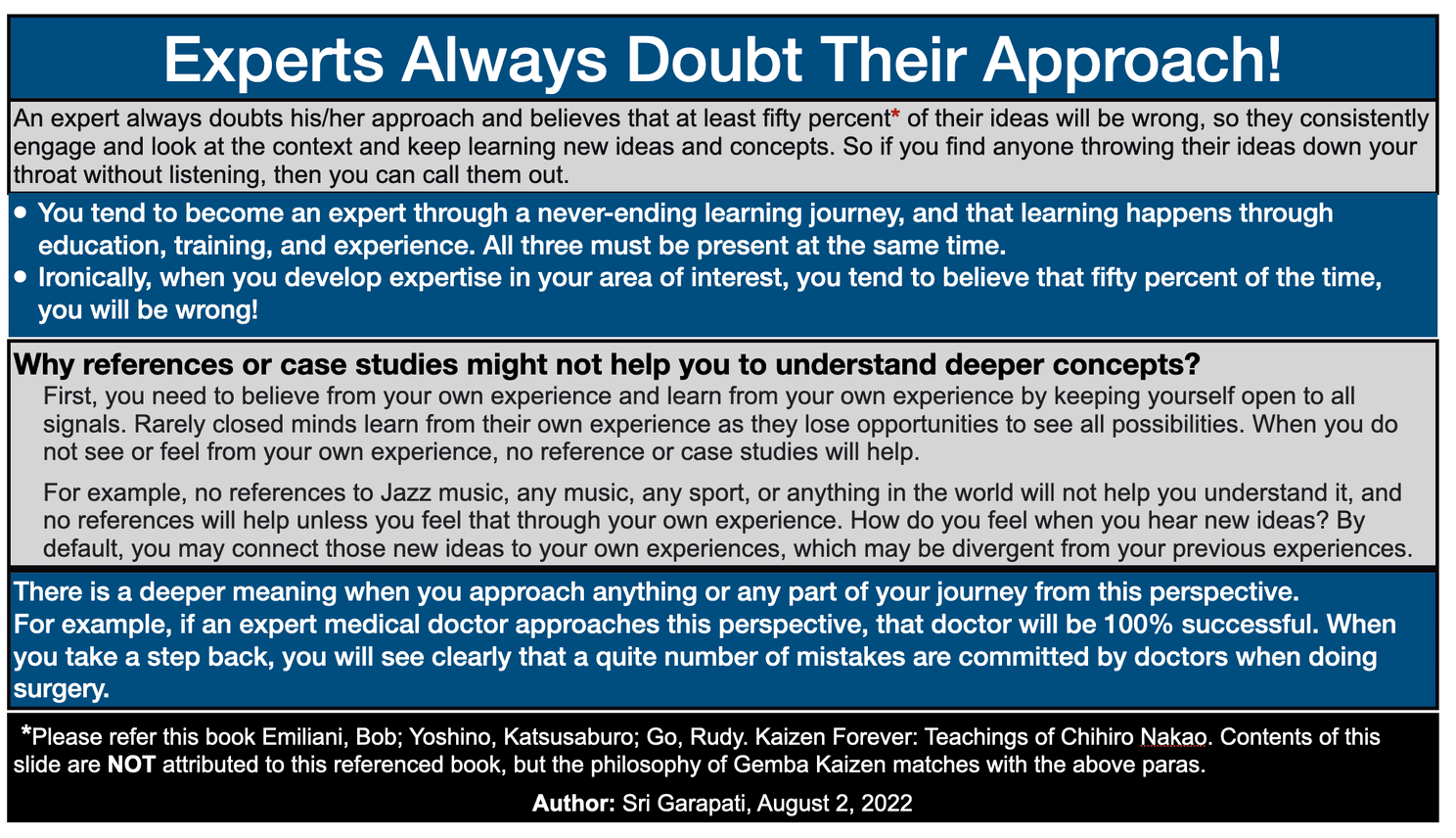
As the nature of the system can always play havoc with us, please ask this question: who is an ideal expert? Experts always doubt their approach and believe that at least fifty percent[2] of their ideas will be wrong, so they consistently engage, look at the context, and keep learning new ideas and concepts. So, if we find anyone throwing their ideas down our throats without listening, we must call them out.
How can any one of us become an expert in a particular domain? Though there are several learning models for becoming a master, the following are general guidance. When we aim to elevate our consciousness and desire to become experts, keep asking questions. How can we be on a path to being an expert in a particular domain? Tend in a direction to become an expert through a never-ending learning journey, and that learning happens through education, training, and experience. All three must be present simultaneously for the effectiveness of learning to manifest and become an expert in our field of interest. That learning must be broad enough to see Whole systems and potential interactions of all elements and parts of the whole-system thinking. Ironically, when we develop expertise in our area of interest, we believe we will be wrong at least fifty percent of the time![2] So, an ideal expert is one who always doubts their approach. If any of us think they are experts and behave like known-all, they must return to square one of their learning cycle.
Why Must We Pause to Think Deeper to Understand the Nature of Our System and the Consequences of Our Interventions?
Is there any dearth of examples where, when outside best practices/methods were adopted, we have only seen sub-optimal outcomes or, in some situations, worse than before?
Suppose we like that concept or new idea in the case studies or reference examples in an outside environment of some other organizational system or perceived "success" of a "celebrity" of some sort; we show eagerness to adopt those exact methods without asking more profound questions to understand the nature of the application in our environment, and not understanding the thinking behind the contextual problems stakeholders in that environment were attempting to solve their problems, what will be results of that adoption in our environment? What does the history of such actions teach us? The following quote from Dr. W. Edward Deming is more apt:
"Experience teaches nothing. In fact there is no experience to record without theory… Without theory there is no learning… And that is their downfall. People copy examples and then they wonder what is the trouble. They look at examples and without theory they learn nothing."In any organizational environment, for several reasons, managers and leaders, in particular, always look for outside sources and references to discover a "silver bullet" for their challenges and may seek "expert" or "authority" advice. What does the history of such interventions teach us, both in organizational and individual personal environments? If we are fortunate to encounter real experts, we may get good advice that could solve our problems. However, unfortunately, as any solution has dimensions of space and time, the likelihood of the emergence of unintended consequences will manifest in time or space (at some other location in organizational systems or for a human being in some other body part when a particular medical intervention goes wrong, for example) and that resulting interventions could be the end of life for both organizations and individuals in the worst-case scenario or loss of precious resources- time and money. When we dig into the literature, we can find several manifested examples of how and when interventions got worse in the past in organizational environments, societies, and individual humans; any discerning individual can discern this in their own life's journey.
What Are the Alternatives We Have to Meet Our Challenges in Our Context?
First, we must believe in and learn from our experience by keeping ourselves open to all signals in the system we were living, and most importantly, the realization that experience can and will be deceptive when our mind cannot scan the whole system and develop systems thinking abilities and understand the theory(ultimate why) behind our particular experience; analyzing any problem or our own experience won't get us anywhere when systems thinking is not our capability, an analysis will only help you to see the symptoms, not interactions that are not visible to senses. When we don't see or feel the whole system from our own experience, no reference case studies, examples, or "expert" advice will help. Rarely do closed minds learn from their own experience as they lose opportunities to see all possibilities. Who wants to be a closed-minded person?
It is challenging for many of us to see the whole system and learn from our own experiences in our context, so it is imperative to be seconded by others' experiences in similar situations and ask questions to understand the nature of the "solution" - methods and practices. Often, adding contrarian thinking to systems thinking opens up more possibilities. (For additional insights on contrarian thinking, see the Polarities in Life article here) [3]
A word in any human language is a picture of our experience; we can't find the meaning of any word in any dictionary except by feeling that with our experience—one reason why most of us interpret each word differently is when our experiences do not match. As mentioned, learning happens through education, training, and experience. How we would like to educate ourselves is up to us. To get educated, some prefer listening to experts, while others use other channels like reading books, watching videos/podcasts, etc. Ultimately, we will need to experience what we have studied. "Theory without experience is intellectual play," Immanuel Kant, and learning never happens without understanding the theory behind our experience, as mentioned above! This dilemma of knowing both theory and experience in learning is one reason to ponder this challenge of learning and why we must use our natural abilities to think that 'how we think' is more important than 'what we think.' For example, no references to Jazz music, any music, any sport, or anything in the world won't help us understand it, and no references will help unless we feel that through our own experience. How do we feel and think when we hear new ideas? We may connect those to our own previous experiences that have already manifested, and by not questioning, we will close the options and choices of future possibilities; this means driving forward by looking through the rear-view mirror.
There is a deeper meaning in our journey when we approach in anticipation of a solution to any perceived or real problem from the perspective of the arguments presented in this article, which will help to elevate our consciousness (with an assumption that we continuously work to elevate our consciousness, our current world-view may be outdated already); this way of thinking helps us to be aware or realize the potential possibilities of unintended consequences of actions that we may take, as suggested by "expert" advice or following case studies from other contextual environments. When we seek advice or study other case studies, that action will increase the possibilities of options and choices for intervention in our system, provided we understand the theory behind that intervention. Still, applying the same method as others could worsen our system's situation when some of the arguments presented in this article are not considered.
For example, if an expert medical doctor approaches surgery from this perspective, that doctor will tend towards one hundred percent success. However, when we take a step back, we will see clearly that expert doctors also make quite a number of mistakes when performing surgery. Please refer to iatrogenic(medical error) deaths[ 4]. Engineers and scientists can also avoid a similar situation when designing, developing, and launching a space vehicle into outer space or developing any other product for any context.
When we attempt to elevate our consciousness to cosmic levels, would not complexity be reduced or disappear altogether, making it easier to understand all interactions of the systems we manage?
Henceforth, what must we do when an "expert" advises us to solve our problems?
References:
[1] The following is one reference, a primer for systems thinking. For extensive knowledge, please also consider the works of Russel Ackoff, Ghrajedhagi et al.
Donella H. Meadows, Thinking in Systems, a primer, Chelsea Green Publishing, VT, USA, 2008,
[2] Emiliani, Bob; Yoshino, Katsusaburo; Go, Rudy. Kaizen Forever: Teachings of Chihiro Nakao, The CLBM Publishing, Connecticut, USA, 2015.
[3] Medical error- the third leading cause of death in the UShttps://www.bmj.com/content/353/bmj.i2139
[4] Polarities in life:https://circle.tameflow.com/c/resources/polarities-in-life